

The defense technology landscape is undergoing a fundamental transformation. Across cybersecurity, autonomous systems, artificial intelligence, and mission software, industry leaders are responding to a new reality: the pace of technological change is accelerating, and the demands of the modern warfighter require solutions that move from concept to deployment faster than ever before.
For executives leading some of the sector’s most innovative companies, the formula for success is increasingly clear: deep mission understanding, commercial-grade agility, technology integration, and an unwavering focus on customer outcomes. It is in this environment that investment banking firm Piper Sandler hosted its first-ever Government and Defense Technology CEO Summit in Washington, D.C., in September.
From Transformation to Mission Alignment
For Dave Wajsgras, Chairman and CEO of Everfox, transformation has been a recurring theme throughout his career. His experience leading Intelsat through a transition from a traditional bandwidth provider into an end-to-end solutions company shaped his perspective on how organizations must evolve to meet changing customer needs.
“Intelsat was a successful transformation moving from a bandwidth company to an end-to-end solutions provider with a successful exit in July 2025,” Wajsgras said. “Joining Everfox was an easy decision. I knew much of the team from working at Raytheon.”
Today, Wajsgras sees Everfox positioned at the intersection of advanced cybersecurity and national security requirements. The company operates in two core areas: cross-domain solutions and insider threat protection.
“Everfox is a software-based business,” he said. “It’s a defense technology company with a go-to-market motion similar to a commercially proven company.”
The company’s cross-domain solutions focus on securing data movement across organizational boundaries, while its insider risk capabilities protect government networks and critical infrastructure. Wajsgras believes the combination of advanced technology and mission-focused execution creates a differentiated position in the market.
His leadership approach draws from experiences at both Raytheon and Intelsat. “The Raytheon experience afforded me an understanding of how to operate at the heart of the mission, at scale,” he said. “At Intelsat, the goal was to transform the company to address the evolving needs of global communications. This has prepared me for what we are seeing from Everfox’s customers.”
Wajsgras also highlighted the role of investment partners in accelerating technology companies. “TPG is the best private equity investor in the defense technology space,” he said. “They understand the technology. They understand how to manage companies and support leadership teams. It is a winning formula from an investor perspective.”
Technology Advantage Through Integration
At MANTECH, CEO Matt Tait describes the company’s mission through a simple principle: technology must create an advantage for those who rely on it.
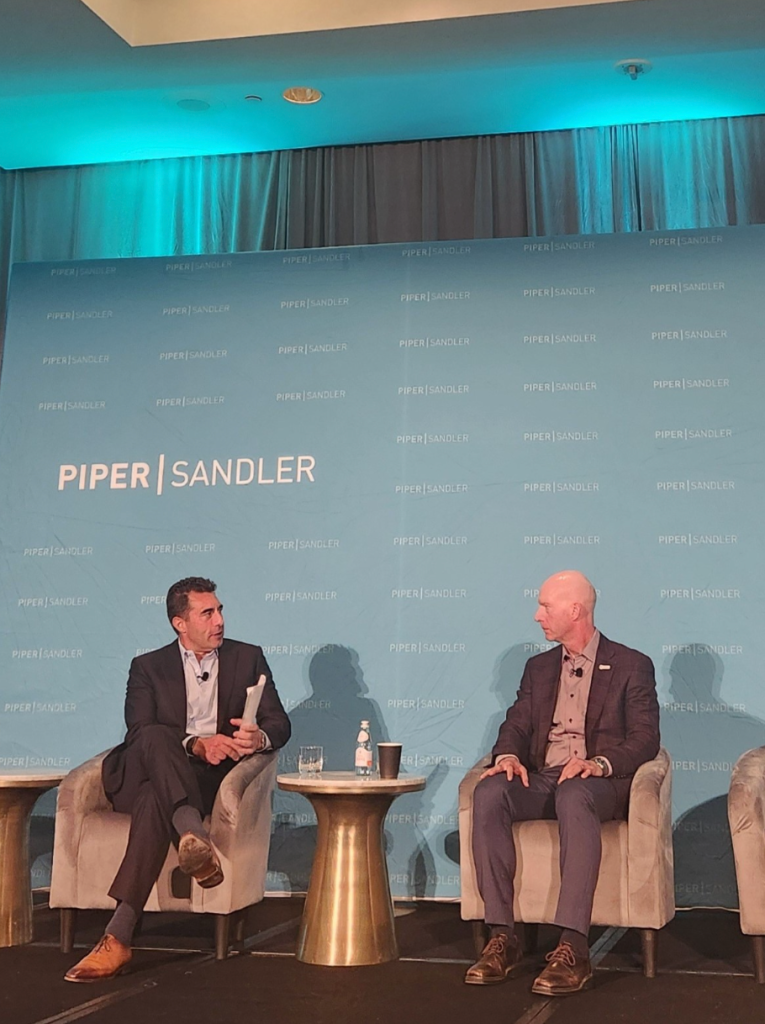
“The reason why I am at MANTECH is because we are country first and mission always,” Tait said. “We make sure that for our warfighter it is not a fair fight. We have the advantage.”
The company is a high-tech, high-end technology provider, leading in cyber, data and AI, and digital modernization. Tait emphasized that modern challenges require more than isolated solutions.
“We are the disruptor of choice from a tech and capability perspective,” he said. “MANTECH does more offensive cyber than anyone else in the market. We are playing a part in every single headline.”
Tait believes success in today’s environment comes from combining multiple capabilities rather than searching for a single transformative technology.
“There are no silver bullet solutions out there,” he said. “It is the combination of different capabilities and technologies that will meet the mission.”
The company’s AI strategy reflects this approach. MANTECH describes its AI efforts with the phrase “See It Solved,” emphasizing practical outcomes over experimentation without purpose. “In an environment where the industry average for implementing AI initiatives is 20 percent, MANTECH’s AI implementation rate with clients is 90 percent,” said Tait.
“We have mastered AI-infused Cyber,” Tait said. “With offensive cyber you need to be right once, whereas with cyber threat protection every day has to be a good day.”
Delivering Innovation at the Speed of the Mission
Amy Gilliland, President of General Dynamics Information Technology (GDIT), sees the current environment as more complex and contested than ever, one defined by unprecedented technological disruption.
“Technology change is facilitating unparalleled disruption and transformation,” Gilliland said. “It is changing how we need to empower the battlefield in some of the most disconnected environments. Our primary advantage is no longer firepower — it’s dependent on tech — AI, data at the edge and multi-domain operations.”

For large defense technology providers, innovation must be balanced with scale, reliability, and speed. Gilliland believes customers increasingly expect solutions that can move quickly from development to operational use.
“There is a sense of urgency and an expectation of companies like GDIT to bring agile solutions forward to solve immediate mission challenges,” she said. “The prime contractors like GDIT are innovating at scale.”
The shift toward rapid delivery accelerated after the COVID-19 pandemic, when organizations recognized their technical debt and placed greater emphasis on proven capabilities and immediate results.
“In the aftermath of COVID, CIOs and the mission demanded proven solutions, not PowerPoints,” Gilliland said. “It was clear that we as a company needed to invest ahead of need, for instance in cyber and AI.”
That investment requires not only technology but also people who understand the mission and can execute quickly.
“An important part of investing in technology is having the employees who are committed to getting the best technology to the warfighter quickly,” she said. “That requires the right mindset, fast prototyping and agile solution development.”
For Gilliland, trust remains the foundation of successful mission partnerships.
“What comes with mission intimacy is both knowing the customer and trust,” she said. “That trust has to be built all of the time.”
The goal, she emphasized, is not technology for technology’s sake. It is to deliver practical capabilities that solve real mission challenges.
“I don’t need science projects,” Gilliland said. “I need solutions that can be delivered.”
The Future of Defense Technology
Across Everfox, MANTECH, and GDIT, a common theme emerges: the future of defense technology will be shaped by organizations that can combine innovation with execution.
The next generation of mission capabilities will not come from individual technologies operating in isolation. Instead, leaders across the industry point to integrated systems, close customer relationships, rapid development cycles, and a commitment to operational performance as the defining elements of success.
In an era where technological advantage increasingly influences mission outcomes, the companies that understand the customer, move with urgency, and deliver solutions at scale will help define the future of defense innovation.
The author, Marc Hausman, is CEO of Strategic Communications Group, which publishes Modern Integrated Warfare and Government Technology Insider.