

Originally published on Modern Battlespace and written by David Presgraves, this article explores how the future of military operations will be shaped by autonomous solutions. It highlights how advanced technologies, such as collaborative autonomy and Launched Effects, are being integrated to improve the Army’s capabilities, with a focus on the U.S Army’s Experimental Demonstration Gateway Event (EDGE 24). With a focus on extending reach, survivability, and lethality while reducing human risk, the article explores how these advancements are paving the way for the Army.
One of the primary goals of events like the U.S. Army’s Experimental Demonstration Gateway Event (EDGE) is to project and meet the goals of the Army of 2030 and beyond. With threat systems becoming more lethal and data systems more complex, the Army is turning to autonomous solutions that can extend its reach, survivability, and lethality while keeping the human element – to the greatest extent possible – out of tactical risk.
This year’s EDGE 24 event focused on the convergence of autonomous capabilities in support of the Army’s aviation branch. Collins Aerospace and Raytheon teamed up at the event to demonstrate how to leverage their merged collaborative autonomy solutions with Launched Effects, while maintaining human on-the-loop command.
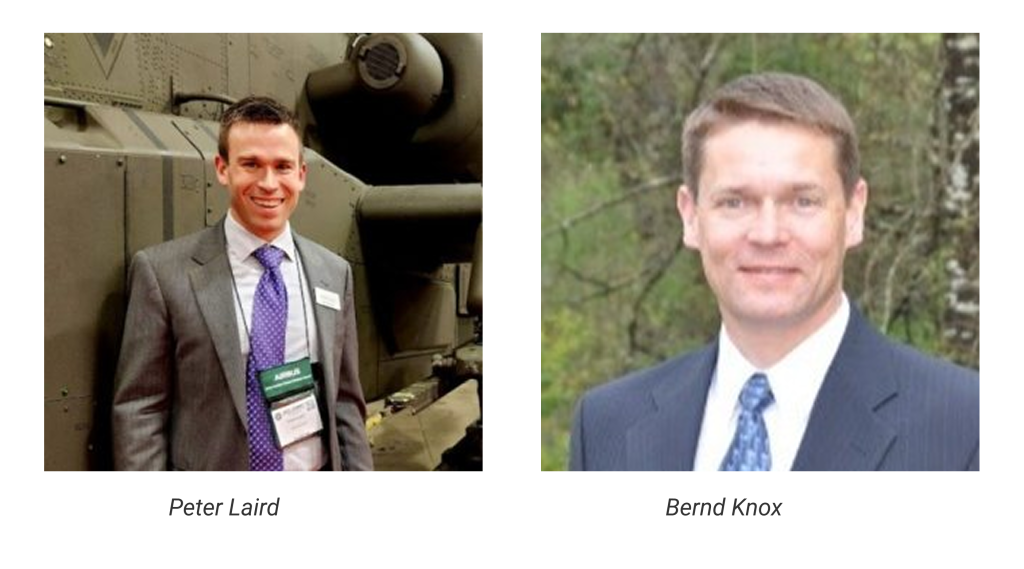
To learn more about the collaborative autonomy demonstrations and why they are a game changer for the U.S. Army, we recently sat down with Collins Aerospace’s Senior Manager of Business Development, Bernd Knox, and Senior Principal Systems Engineer, Peter Laird – who participated in the EDGE 24 demonstration.
The Modern Battlespace (TMB): What is the U.S. Army’s Experimental Demonstration Gateway Event (EDGE)? What does it set out to achieve?
Bernd Knox: EDGE is sponsored by the Future Vertical Lift Cross-Functional Team (FVL CFT). It is an experimentation event where industry partners are invited to bring their technologies to fit into the overall goal of meeting the capability needs of the Army of 2030 and the Army of 2040. The event focuses on future capability needs and identifying and developing the technology to solve those needs.
EDGE 24 in particular was dedicated to the convergence of technologies to meet the aviation branch of the Army’s broader capability needs. It focused on understanding Launched Effects and their operational employment in tactical scenarios.
Peter Laird: EDGE is not just a show-and-tell by industry. The Army’s intent is to experiment and determine which technologies work for them, which don’t, how certain capabilities can be leveraged, as well as how multiple systems can be integrated.
Bernd Knox: Military users don’t always understand what industry can do, so events like EDGE give the Army insight into industry’s state-of-the-art technologies, allows them to experiment in realistic scenarios, and then helps them better understand what capability requirements they should be getting after.
This year’s EDGE was a wholly collaborative autonomy and Launched Effects event. The Army invited industry to demonstrate Launched Effects to see if it’s ready to field and meet their capability needs that they are looking for in the next few years. They conducted an operational vignette to learn how Launched Effects can be used in battle in order to evaluate the efficacy of the entire operational concept.
TMB: What are Launched Effects? What role did they play during EDGE?
Bernd Knox: Launch Effects are a specific part of collaborative autonomy and robotics. It has evolved from something that is growing beyond just the air domain. Autonomy, in general, is now being recognized as a potential operational and warfighting capability paradigm. Launched Effects are a part of that, now growing into all maneuver domains – ground, sea, and air. The industry partners that came to this year’s event demonstrated all the flavors of that.
“Collins Aerospace and Raytheon went to EDGE collaboratively. Our warfighting scenario was to employ our two dissimilar autonomy systems to demonstrate how we can get them to work together.” -Bernd Knox
Peter Laird: Launched Effects, at the end of the day, are an additional sensor, and the ability to move that sensor data around is all part of the ecosystem of Launched Effects. During the event, there were multiple vehicles in multiple situations all showcasing that type of autonomy.
Bernd Knox: Ultimately, what Launched Effects is intended to do is extend the reach, survivability, and lethality of manned platforms. Using robotics autonomy, collaborative autonomy, and unmanned systems can enable the Army to keep the human aspect out of tactical risk. These technologies and systems also bring the sensing and lethality beyond the manned platform so that human operators are not making first contact with the enemy. Launched Effects accomplishes that. You can have teams of relatively autonomous vehicles that will go forward and provide targeting information. The idea is that you can assign them a mission objective in a certain area, and the autonomy is capable enough to accomplish a meaningful military task without constant supervision.
TMB: Two autonomous solutions – RapidEdge and CODE – were employed during EDGE. How were they leveraged and what results did the demonstrations yield?
Bernd Knox: Collins Aerospace and Raytheon went to EDGE collaboratively. Our warfighting scenario was to employ our two dissimilar autonomy systems to demonstrate how we can get them to work together. That was one of the learning demands of the FVL CFT. It’s relatively useful to have stovepiped systems that work in your ecosystem, but it’s far more useful to be able to get them to communicate, interact, and provide meaningful military outcomes. And that’s what we did.
RF sensing and geolocation were the Collins team capabilities, which were able to locate some notional high-value threat systems. We passed those targets off to the Raytheon team to then visually identify them with their CODE (Collaborative Operations in Denied Environment) solution. Data distribution, target locating, and information pass-off happen automatically. That process demonstrated the collaborative autonomy piece of it. It eliminated the need for a human operator to receive a report, interpret it, and then retransmit it to something else. It all happens seamlessly within the network, passing from one system to another.
Peter Laird: RapidEdge itself is a set of systems, processes, design approaches, and tools – including our mission planning and our simulation tools – that allows us to go through rapid iterations to get the results that were demonstrated at EDGE. In some ways, RapidEdge is our bet that the autonomy solutions are needed to be successful in 2030, and beyond. Both Collins and the Army are experimenting now to figure out what works, what are the right ways to accomplish these things, and RapidEdge is that set of systems and tools to rapidly iterate on that. For only four months, we had our hands on the vehicle flown at EDGE. So it was a proof point for the fact that we can rapidly integrate effective autonomy on new platforms and integrate with new systems very quickly.
Another aspect of what we were showing is how you do the planning and employ the team. Instead of commanding or remotely piloting a vehicle, you give a commander’s intent and a mission objective to a team. We showed that through a mission planning stage, as well as multiple replans and re-tasks while actually in the air, we can react to new intel that was received on the ground.
“The goal is to accomplish more with fewer human resources in the mix. The way to accomplish that is to create smart systems, give them a playbook of things they can do that are defined, and then the human operator can give them broad objectives to complete.” -Peter Laird
We used the Army’s Scalable Control Interface (SCI) to do the initial mission tasking and to load a mission plan. It also received data as we went, with data coming back on WINTAK and ATAK systems. We also had the data being dispersed to the Army’s Tactical Operations Center (TOC). The Raytheon team took the data and acted on it.
We were able to re-task the team with new objectives, through both the SCI and the ATAK tablet, to give new mission commands while the team was already in the air. A key takeaway from that is that there wasn’t a pilot who had to go command the team or fly a specific vehicle to a new spot. If the commander needed the team to take a photo of a new spot to do battle damage assessment of a specific area, the team took that command and assigned the correct assets that were already in the air and able to execute the task. It was literally just the press of a button and a confirmation.
TMB: Why is it important for the U.S. Army to be able to execute a mission that merges collaborative vehicle autonomy with human on-the-loop command?
Bernd Knox: The importance stems from the increasing complexity of the modern battlefield. Threat systems are becoming more lethal. Data systems are becoming more complex. More information is flowing and the human operators are becoming more tasked. The idea is to give human operators more tools to extend reach, survivability, and lethality, but not necessarily give them more things to do.
The collaborative autonomy piece extends the capability of the manned platforms affordably without presenting human operators with more tasks to manage and track. The goal is to accomplish more with fewer human resources in the mix. The way to accomplish that is to create smart systems, give them a playbook of things they can do that are defined, and then the human operator can give them broad objectives to complete. The autonomy systems then figure out how to do that.
The ultimate objective is not necessarily to provide increased capability with increased cognitive load for that human who’s managing a multitude of systems. Instead, we give them an extra toolset to accomplish tasks without increasing the workload.
Peter Laird: Another primary goal is to get better data. You’re going to increase mission effectiveness while also increasing standoff of manned platforms and the personnel themselves. We want to be able to keep people and their assets safe while getting better data. That is a win-win.
And in an environment where the size of our Army is shrinking, when we talk about remotely piloted aircraft, we are talking about equipment that takes more than a dozen humans to fly. We want to be able to flip that from needing many humans for one vehicle to having one – or on average, less than one – human controlling many platforms and sensors.